
Mifflin Projected and Actual Release
A projected date is an estimate or calculated future point. An actual release date records a custody event that has already occurred. Pennsylvania sentence records add more terms: the judicial minimum is ordinarily the first point when parole may be considered, while the judicial maximum is the outer term of the sentence as lawfully calculated. Eligibility is not approval. Even a Board Action granting parole does not prove that a person has crossed the prison gate.
For a person held at Mifflin County Correctional Facility before trial, no fixed release date may exist. Bail can be posted, charges can change, and a judge can enter a later order. MCCF must receive and process the court paperwork. Its family guide says workload can affect timing and release occurs as soon as practical. A docket entry therefore supports the legal authority but does not supply an exact physical exit time.
- Judicial minimum
- The ordinary first parole-eligibility point under an indeterminate sentence.
- Judicial maximum
- The outside sentence term after lawful calculation, credit, and later orders.
- Detainer
- A hold or demand from another authority that can prevent community release.
- Recommitment
- A return to custody that may lead to sentence recalculation after a violation.
Find Mifflin Projected Release Dates
The correct route begins with jurisdiction. Mifflin County terms, Pennsylvania state sentences, and federal sentences use different records. Do not treat a federal projected date as a PA DOC field. Do not search the state locator for an MCCF-only county sentence and assume no result means release. A name match is also weaker than a docket, inmate number, or parole number.
- Identify the sentence and custodian. Read the UJS Case Search docket for a Mifflin County case and note the sentencing order, minimum and maximum language, credits, and later amendments.
- For an MCCF county term, ask the committing court and MCCF Records which existing record shows the controlling sentence calculation. The facility's main number is 717-248-1130, with Records at extension 2321.
- For a state sentence, use the PA DOC locator to confirm current custody or, after release, active state supervision. Obtain future minimum and maximum calculations through the proper court, DOC, parole, person, or record channel because the public result does not show them.
- For federal custody, use the BOP locator and label a future release date projected. BOP dates can change and do not answer a Pennsylvania county or state sentence question.
- Register with PA SAVIN for a custody-change alert, then verify whether the event was community release or transfer to another authority.
The Mifflin County release-record search can help when the first task is identifying which agency controlled custody. That distinction must come before interpreting a date.
Note: A transfer out of MCCF ends local custody but is not an actual release to the community.
Mifflin Projected Date Quirks
Pennsylvania's public locator does not expose a field named Projected Release Date, Tentative Release Date, Minimum Sentence Date, or Maximum Sentence Date. This is a positive research finding, not a gap to fill with a guess. The Inmate Locator mode shows current PA DOC custody. The Department Supervised Individual Locator may show an actual field labeled Release Date after a person leaves state physical custody and remains under field supervision.
The official PA DOC search displays both locator modes.
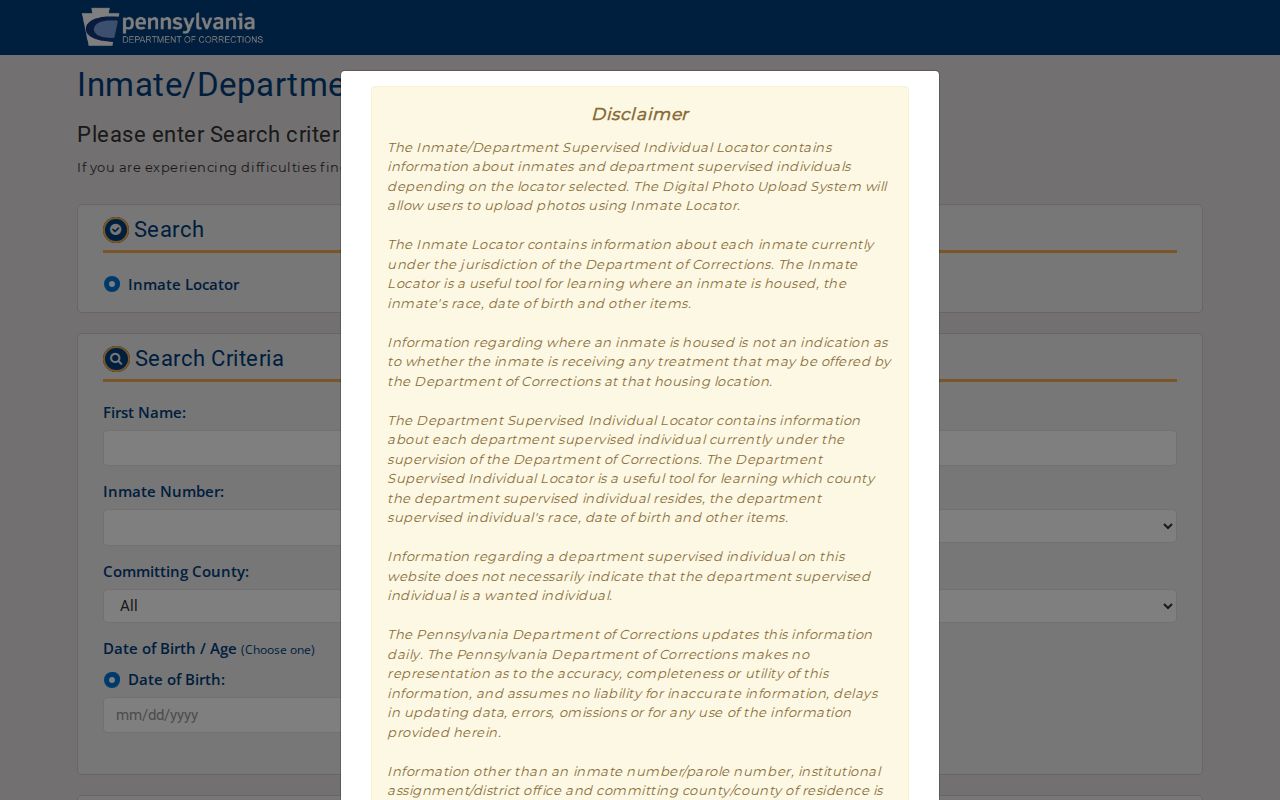
The image shows why the modes must not be blended. A current inmate result is not a public future-date record, while an active supervised-person result can contain the actual Release Date, a linked supervision location, committing county, update time, and an absconder flag.
DOC calculates operative minimum and maximum dates for state parole work, but public confirmation may require the sentencing docket, an authorized person channel, or a records request. Fully discharged people may also disappear from the supervised-person mode. The old court and agency records then become more important. Pennsylvania also has no blanket 85 percent rule, and its RRRI fractions must not be relabeled as one.
Mifflin Sentence Date Framework
Pennsylvania generally uses indeterminate sentences under 42 Pa.C.S. § 9756. A sentence has minimum and maximum terms. The minimum usually marks the first point at which discretionary parole can be considered. The maximum is the outside judicial term, subject to lawful credits, aggregation, amended orders, and recommitment effects. Neither number alone proves the actual release date.
The Pennsylvania parole process says DOC performs sentence-date calculations and the Parole Board decides release within its jurisdiction. Under 61 Pa.C.S. § 6137, authority and exclusions depend on the sentence. A life sentence ordinarily falls outside normal parole release authority without commutation. Other mandatory or special provisions can govern a particular case.
| Date or record | What it means | What it does not prove |
|---|---|---|
| Judicial minimum | Ordinary first eligibility point | A grant or scheduled exit |
| RRRI minimum | Potential earlier eligibility for a qualifying person | Automatic parole |
| Judicial maximum | Outer sentence term as calculated | No other case or detainer exists |
| Board Action | Individual parole decision | Physical release already happened |
| DOC Release Date | Actual field on an active supervised record | A future projection or full discharge |
| Court order date | Legal action entered on the docket | The exact MCCF exit time |
Mifflin RRRI Release Eligibility
There is no blanket Pennsylvania rule requiring every state prisoner to serve 85 percent of a sentence. That claim imports a rule that does not describe Pennsylvania's ordinary minimum and maximum framework. The closest relevant earned-time-like alternative is the Recidivism Risk Reduction Incentive, commonly called RRRI. It changes a possible eligibility point for a person who qualifies under the statute. It does not guarantee release.
Under 61 Pa.C.S. § 4505, the RRRI minimum is generally three-fourths of a minimum term of three years or less, and five-sixths when the minimum exceeds three years. Those fractions equal 75 percent and about 83 one-third percent, not 85 percent. The sentencing court must make the relevant determination, and the sentenced person must meet the law's eligibility and program conditions.
RRRI is still a parole-eligibility framework. Plan approval, Board action, detainers, conduct, and processing can affect the path. For an MCCF county sentence, do not apply a state RRRI calculation unless the actual order and jurisdiction support it. Ask the committing court and MCCF Records for the controlling record.
Note: Never subtract a percentage from a sentence and publish the result as a confirmed Mifflin County release date.
Why Mifflin Release Dates Change
A sentence date may change for lawful reasons before or after parole review. Some changes correct the calculation. Others reflect new court action, conduct, or custody under another authority. The exact effect is case-specific. A date on an old document should be checked against newer orders and the agency that currently controls the person.
| Factor | Possible effect | Best record to check |
|---|---|---|
| Presentence credit | Changes time credited toward the sentence | Sentencing order and official calculation |
| Amended court order | Corrects or changes controlling terms | UJS docket and signed order |
| RRRI eligibility | May create an earlier parole-eligibility minimum | Sentence and DOC/parole calculation |
| Parole grant or refusal | Allows conditional release or keeps the person confined | Board Action |
| Detainer or hold | Can move the person to another custodian instead of the community | Facility record and receiving agency |
| Misconduct or plan status | Can affect eligibility or completion of release steps | Responsible corrections or parole channel |
| Violation and recommitment | Can return a released person to custody and alter dates | Board, court, and DOC records |
“Parole to detainer” is a key warning. It can mean parole from one sentence into continued custody elsewhere. The person may have a release event in one record without a community release. Likewise, disappearance from MCCF may be a transfer to PA DOC, another county, USMS, or ICE.
Mifflin Parole Date Review
A minimum sentence date starts a possible review path. It does not set the final release day. Under 61 Pa.C.S. § 6135, the Pennsylvania Parole Board considers factors that include the offense, recommendations, background, institutional conduct, prior record, victim information, and other matters named in the statute. The official interview process says an application ordinarily need not be considered more than six months before the minimum date. A prior reconsideration date can also control when another review occurs.
Some Short Sentence Parole-eligible cases may follow a process without the usual interview. That procedural difference still does not convert eligibility into guaranteed release. The Board may grant or refuse parole. If granted, release can remain subject to an approved plan, detainers, document completion, and agency processing. Monthly statistics show categories such as parole to street, parole to detainer, refusal, and recommitment, but those totals cannot answer when one named person will leave.
An individual result is recorded in a Board Action. There is no official public person-level decisions database or named-inmate hearing calendar in the materials reviewed. Use the Board's contact or proper record channel for that decision. After physical release to state parole, the supervised-person locator may show an actual Release Date and office. For county parole or probation, contact the Mifflin County office because the state locator does not cover every county-supervised person.
Violation proceedings can also change the path after release. Detention on a parole warrant, a preliminary hearing, a later violation hearing, and recommitment can return a person to custody and require recalculation. An older projected date should never be read without checking later Board and court action.
Confirming Mifflin Actual Release
A future date should be followed through to an actual custody event. PA SAVIN through VINELink can send notices for county jail, state prison, and state parole changes. Register before the expected event and read the exact wording. A movement or transfer alert is not community release. For an MCCF matter, pair the alert with the court order and facility record when precision matters.
The Mifflin County VINELink inmate search covers the one-person alert process. For state parole, compare the actual DOC Release Date with the Board Action and supervision location. For a federal sentence, read the BOP result in its own scope. “Released” from BOP means no longer in BOP custody and may coexist with another custody or federal supervision.
No database should be treated as an exact exit clock unless the record says so. Preserve the source, access time, identifiers, and exact status wording. If sources conflict, ask the controlling facility or agency for the existing release, transfer, or sentence-calculation record.